
Texas Tribune.
El gobernador Greg Abbott quiere limitar más la velocidad con la que los valores de las propiedades pueden aumentar en un intento por ofrecer alivio de impuestos a la propiedad a propietarios de viviendas y empresas, pero los expertos en política fiscal de todo el espectro político advierten que la propuesta no abordaría las causas fundamentales de las facturas de impuestos más altas y sería contraproducente con graves consecuencias.
El valor de una propiedad es un factor clave en la ecuación que conforma la factura de impuestos del propietario. Esta factura se determina multiplicando el valor de la propiedad por la tasa impositiva establecida por los distritos escolares, las ciudades, los condados y otras jurisdicciones fiscales.
Los propietarios de viviendas en Texas han experimentado fuertes aumentos en sus tasaciones desde principios de la década, con el auge económico del estado, y se han quejado de que estos mayores valores inmobiliarios están incrementando sus facturas de impuestos. Los propietarios experimentaron aumentos persistentes en el valor de sus viviendas, ya que la feroz competencia por las viviendas ejerció presión sobre el limitado parque inmobiliario de Texas y elevó los precios. Estos aumentos se han moderado desde entonces, pero siguen siendo motivo de preocupación para los propietarios.
Actualmente, el estado limita el aumento anual del valor imponible de la residencia principal de un propietario al 10 %. El estado promulgó ese límite en la década de 1990 para evitar que los propietarios de viviendas en mercados inmobiliarios en auge sufrieran grandes impactos en sus impuestos.
Abbott quiere reducir ese límite al 3% y extenderlo a los propietarios de todo tipo de propiedades, como supermercados, restaurantes y edificios de apartamentos, con el objetivo de darles a los propietarios más previsibilidad en lo que respecta a sus facturas de impuestos.
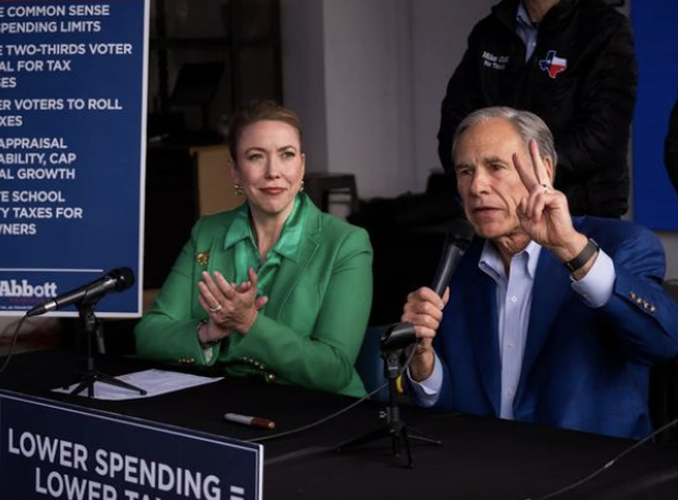
“Conozco a muchas personas que cuando reciben su tasación, les tiembla la mano con el sobre en la mano porque tienen miedo de ver cuánto aumentan sus impuestos a la propiedad”, dijo Abbott en un evento la semana pasada en Fort Worth, donde defendió sus propuestas.
La propuesta de valoración de Abbott es una parte clave de la plataforma de reducción de impuestos a la propiedad del gobernador que está al frente y en el centro de su candidatura a la reelección de 2026, que incluye disposiciones para terminar con los impuestos a la propiedad escolar para los propietarios de viviendas y dificultar que los gobiernos locales aumenten los impuestos a la propiedad.
Expertos fiscales de todas las perspectivas políticas entrevistados por The Texas Tribune se mostraron muy escépticos ante esta parte del plan. La campaña de Abbott no respondió directamente a las preocupaciones expresadas por dichos expertos sobre la propuesta. En un comunicado, el secretario de prensa de Abbott, Eduardo Leal, reafirmó que todo el paquete beneficiaría a los contribuyentes.
“Solo en Austin los grupos de interés afirmarían que la solución al aumento de los impuestos prediales es… más impuestos”, dijo Leal. “Texas acaba de invertir $51 mil millones en recortes de impuestos prediales locales, sin aumentar los impuestos ni recortar servicios esenciales. La decisión es simple: apoyar a los contribuyentes o obstaculizar el proceso. El gobernador Abbott cree que dar a los votantes más control sobre sus impuestos prediales es esencial para que Texas sea más asequible. Presentará su plan a los votantes para obtener un mandato que permita controlar el gasto local, reformar el deficiente sistema de tasación y, finalmente, dar a los tejanos el control sobre sus impuestos prediales”.
¿Tiene alguna pregunta sobre los impuestos prediales? ¿Han aumentado o disminuido sus impuestos prediales en los últimos años? ¿Tiene dificultades para pagarlos? Envíe un correo electrónico a Joshua a joshua.fechter@texastribune.org.
Buena política, mala política
Tax policy experts on the right and left have long maintained that tight appraisal caps, though they may be good politics, don’t work and have terrible consequences.
Higher property values don’t necessarily mean higher tax bills, tax experts and property appraisers have said, and local taxing entities carry the responsibility of setting tax rates so that tax bills don’t rise exorbitantly even if a property’s value does. In Texas, tax-cut proponents have instead pressed lawmakers to focus on efforts to drive down tax rates and revenue, seen as more surefire ways to slow tax bills.
Abbott’s idea, tax policy experts said, strongly resembles California’s Proposition 13, a 1970s ballot initiative that aimed to reduce homeowners’ taxes after several years of rapidly rising home values by putting tight limits on property value growth and tax rates.
What followed: vast inequities between taxpayers, higher housing costs and tax benefits flowing disproportionately to wealthy homeowners — results that have played out in other places like New York City that have also enacted stricter caps.
“Bringing California-style property tax reform to Texas is just not sound policy,” said Manish Bhatt, a senior tax policy analyst at the conservative Tax Foundation.
The appraisal cap creates a “lock-in” effect in which long-time homeowners who might’ve sold their homes won’t because they’ll lose the tax benefit. That means fewer homes on the market and higher home prices as a result of that scarcity.
“Homeowners are less likely to trade up to a bigger home when they’re purchasing power or family size increases,” Bhatt said. “That means that there’s less supply for newer homeowners and younger families.”
That sentiment is shared on the other side of the political spectrum.
“For a state like Texas that loves to pitch itself as being pro-family and good for families, this is a pretty anti-family policy,” said Neva Butkus, senior analyst at the left-leaning Institute on Taxation and Economic Policy. “That’s going to hinder the ability for young families who are getting married and want to buy their first home and enjoy the perks of homeownership and build some equity and raise their kids in a property that they own. The people that are going to stand to benefit the most are older folks who have owned their homes for a long time, who have a lot of wealth already built up.”
A tighter cap would also make the tax system more unfair, experts said. Under a tighter cap, longtime property owners wind up paying much less in property taxes than newer ones, putting first-time homebuyers and new business owners at a disadvantage. Such a disparity largely doesn’t exist under the state’s current tax system, according to an analysis by the Lincoln Institute of Land Policy.
That disparity does exist in California, said Adam Langley, associate director of tax policy at the Lincoln Institute of Land Policy.
“It’s very common to see identical, side-by-side homes with one person paying taxes that are more than five times higher than their neighbors,” Langley said.
For all of that, local governments may simply set tax rates where they need to in order to collect however much revenue they need to make up for funds lost to the cap. That scenario played out in Cook County, Illinois, where taxpayers eventually wound up paying higher tax bills than they would have without a strict appraisal cap, researchers found.
That dynamic is beginning to play out in Texas. Texas House lawmakers pushed a nearly identical appraisal cap proposal to Abbott’s during the 2023 legislative session. That proposal met stiff resistance from Lt. Gov. Dan Patrick and tax-cut proponents in the Senate. Patrick reiterated his opposition to a tighter appraisal cap Tuesday when he released his own tax cut proposal. The 2023 legislation also garnered opposition from groups representing businesses the proposal was intended to benefit. The concern was that older businesses would benefit at the expense of younger ones.
Lawmakers eventually settled on a compromise, creating a 20% appraisal cap for business properties worth $5 million or less.
There are signs that the policy drove up tax rates. A study commissioned by the Texas Taxpayers and Research Association and Rice University’s Baker Institute for Public Policy found that Collin, Harris, Midland, Moore and Smith counties adopted higher tax rates in 2024 than they otherwise might have to make up for value lost to the cap. Taxes on properties that benefit from the cap fell by $12.8 million while taxes on properties that don’t rose by $14.2 million, those researchers found.
Abbott also wants appraisal districts to appraise properties once every five years rather than every year as they are now. That could lead to homeowners paying taxes on a higher value than they might have on an annual appraisal cycle.
There are other ways to address worries brought on by rising appraisals that don’t carry the same nasty consequences, experts said. Among those suggestions: a “circuit breaker” program that basically caps property tax bills when they exceed a certain percentage of a homeowner’s income. About 30 states and the District of Columbia have programs known as “circuit breakers” that give homeowners a credit or rebate when that happens, which particularly helps lower- and moderate-income households.
Texas lawmakers have occasionally floated and abandoned such an idea, noting the projected cost of administering that kind of program. Texas doesn’t have an income tax, so it doesn’t have a way to verify someone’s income. But states without an income tax, like Washington and New Hampshire, have such programs. Standing up a “circuit breaker” would likely cost less than eliminating school property taxes for homeowners, Butkus said.
Abbott’s plans leave out direct relief for people who rent
Lo que no está en la plataforma de Abbott es cualquier alivio fiscal directo para los 4,3 millones de hogares del estado que alquilan sus casas, en consonancia con años de política de recortes de impuestos del Partido Republicano.
Abbott ha afirmado que los inquilinos de Texas se beneficiarían de su propuesta de límite de tasación, que se aplicaría a los propietarios de viviendas de alquiler. Por otra parte, quienes proponen recortes de impuestos han argumentado con frecuencia que los inquilinos se benefician de los miles de millones de dólares que el estado destina anualmente a los distritos escolares para reducir sus tasas impositivas.
Otros estados cuentan con programas que brindan ayuda directa a las familias que alquilan. Los inquilinos también pueden optar a programas de “disyuntor” en los lugares que los ofrecen, explicó Butkus.
La plataforma de Abbott no aborda otros aspectos de la asequibilidad de la vivienda, como el aumento del costo del seguro de vivienda. El alivio que los propietarios han obtenido en el impuesto predial se ha visto absorbido por el aumento en el costo del seguro, entre otros gastos, según la Oficina del Censo de EE. UU. Este año, los legisladores prácticamente ignoraron las ideas para controlar las facturas de seguros.
La plataforma tampoco aborda cómo controlar la considerable escasez de viviendas en el estado, un factor clave del aumento de los precios de las viviendas y los alquileres. Abbott firmó nuevas leyes bipartidistas este año para reducir la burocracia y permitir la construcción de más viviendas para paliar la escasez. Estas leyes fueron elogiadas por los defensores de la vivienda y Abbott las ha destacado durante la campaña electoral. Sin embargo, no ha dicho si cree que los legisladores estatales deben impulsar más cambios en el futuro.
Abbott necesitará que los legisladores estatales apoyen su programa de recortes de impuestos para que se convierta en ley, y algunos ya lo han hecho. Sin embargo, es probable que se enfrente a la resistencia de Patrick, quien preside el Senado de Texas, para promulgar algunas partes de su plataforma. Patrick se resiste profundamente a aspectos clave del programa de Abbott, como la propuesta de un límite de tasación más estricto.